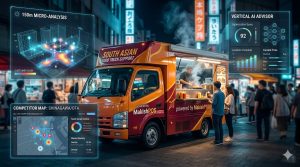
An objective financial overview for restaurant owners considering mobile expansion.
When expanding your South Asian restaurant business to a mobile food truck in Tokyo, understanding predictable operating costs is crucial for mitigating financial risk.
Below is an objective breakdown of standard initial and monthly running costs based on market research and statistics from official Japanese micro-finance and small business organizations.
1. Options for Vehicle Procurement & Startup Capital
According to data from the Japan Finance Corporation (JFC) regarding small food service startups, traditional brick-and-mortar restaurants require an average of 8 million to 10 million JPY. In contrast, a mobile food truck significantly lowers the barrier to entry, especially with short-term or long-term vehicle options.
| Procurement Method | Estimated Cost | Financial Characteristics |
|---|---|---|
| Option A: Vehicle Rental / Lease (Low Risk / Recommended for Beginners) |
150,000 to 250,000 JPY per month |
Requires minimal initial investment (usually a 1 to 2-month security deposit). Ideal for testing market potential without long-term debt. |
| Option B: Vehicle Purchase (Full Ownership / Used or New) |
2,000,000 to 4,500,000 JPY one-time upfront |
Higher initial capital required for procurement and custom kitchen integration (tandoor, specialized grills). Eliminates monthly rental fees. |
- Licensing & Permits: Approx. 10,000 to 20,000 JPY (Tokyo Metropolitan Health Bureau permit, valid for 5 years. Required for both rental and purchased vehicles).
2. Standard Monthly Fixed & Variable Costs
Based on average data compiled by regional small business associations in Kanto:
| Expense Item | Average Market Rate | Objective Description |
|---|---|---|
| Vehicle Rental Fee (If selecting Option A) |
150,000 - 250,000 JPY per month |
Standard market rate for a fully equipped, health-department-compliant kitchen truck in Tokyo. Rates vary by vehicle size (light vs. ordinary truck). |
| Space Rental Fee | 15% - 20% of daily sales |
Unlike fixed shop rent, most Tokyo office lunch spots charge a percentage of daily sales rather than a flat monthly fee. |
| Procurement / Ingredients | 30% - 35% of sales |
Standard Food Cost Ratio (FCR). Fixed restaurant owners can utilize their existing kitchen as a licensed commissary, reducing duplicate inventory costs. |
| Parking & Garage | 30,000 - 50,000 JPY per month |
Required within Tokyo 23 wards. Must comply with local vehicle registration laws to obtain a Garage Certificate. |
| Utilities & Fuel | 20,000 - 40,000 JPY per month |
Includes LP Gas for cooking, gasoline for transportation, and generator/battery electricity. |
| Maintenance & Insurance | 10,000 - 15,000 JPY per month |
Automobile insurance, mandatory liability insurance, and specialized food truck liability insurance (Product Liability/PL insurance). |
3. The Financial Synergy for Existing Restaurant Owners
For individual owners who already operate a licensed restaurant in Tokyo, the financial risk is lowered significantly. Under the Tokyo Metropolitan Government's food safety regulations, a pre-existing licensed commercial kitchen can serve as the official commissary (preparation space) for the food truck. This eliminates the need to rent a separate commissary space, which typically saves an extra 50,000 to 100,000 JPY per month compared to new entrepreneurs starting from scratch.
【Data Sources & Legal Compliances】
- Data references: Japan Finance Corporation (JFC) Food Service Startup Statistics, Tokyo Metropolitan Bureau of Social Welfare and Public Health Guidelines. Average food truck rental industry market scales in Kanto.
- All data points are based on standard market averages as of 2026 and are intended strictly for educational references. Individual results may vary depending on vehicle condition and specific commercial locations.